AI explained
Is AI really new? A history of ideas becoming useful
A brief journey through the ideas behind artificial intelligence, what changed along the way, and why a new capability is not the same as a reliable system.
Rewritten from AI: Is it really something new? A brief chronology (opens in a new tab) · .
Imagine asking a machine a question and getting a reasonable explanation. There is something you do not understand, so you say so, and it explains it another way. Then you ask for an example. The conversation continues so naturally that, for a moment, it is easy to forget everything that had to happen for you to be doing this at all.
Is artificial intelligence really new? The short answer is no, but I understand the surprise. That was the question behind my first chronology, published in 2023 (Acosta Pereira, 2023 (opens in a new tab)). OpenAI had introduced ChatGPT on November 30, 2022, inviting people to converse with the system (OpenAI, 2022 (opens in a new tab)). Faced with an experience like that, another question almost asks itself: when did machines learn to do this?
To answer it, let's step away from that screen for a while. Ahead of us are a question written decades ago, networks that learn from their errors and a Go board. We will follow a difficulty that changes along the way: how to teach a machine something whose every rule we cannot spell out. We will meet it in recognizing images, choosing moves and working with language. This is a selective journey: these lines of work overlap, and none tells the whole history of AI on its own. When we return to the opening conversation, we will be better able to recognize how much of this story was already underway before we saw it appear in a chat.
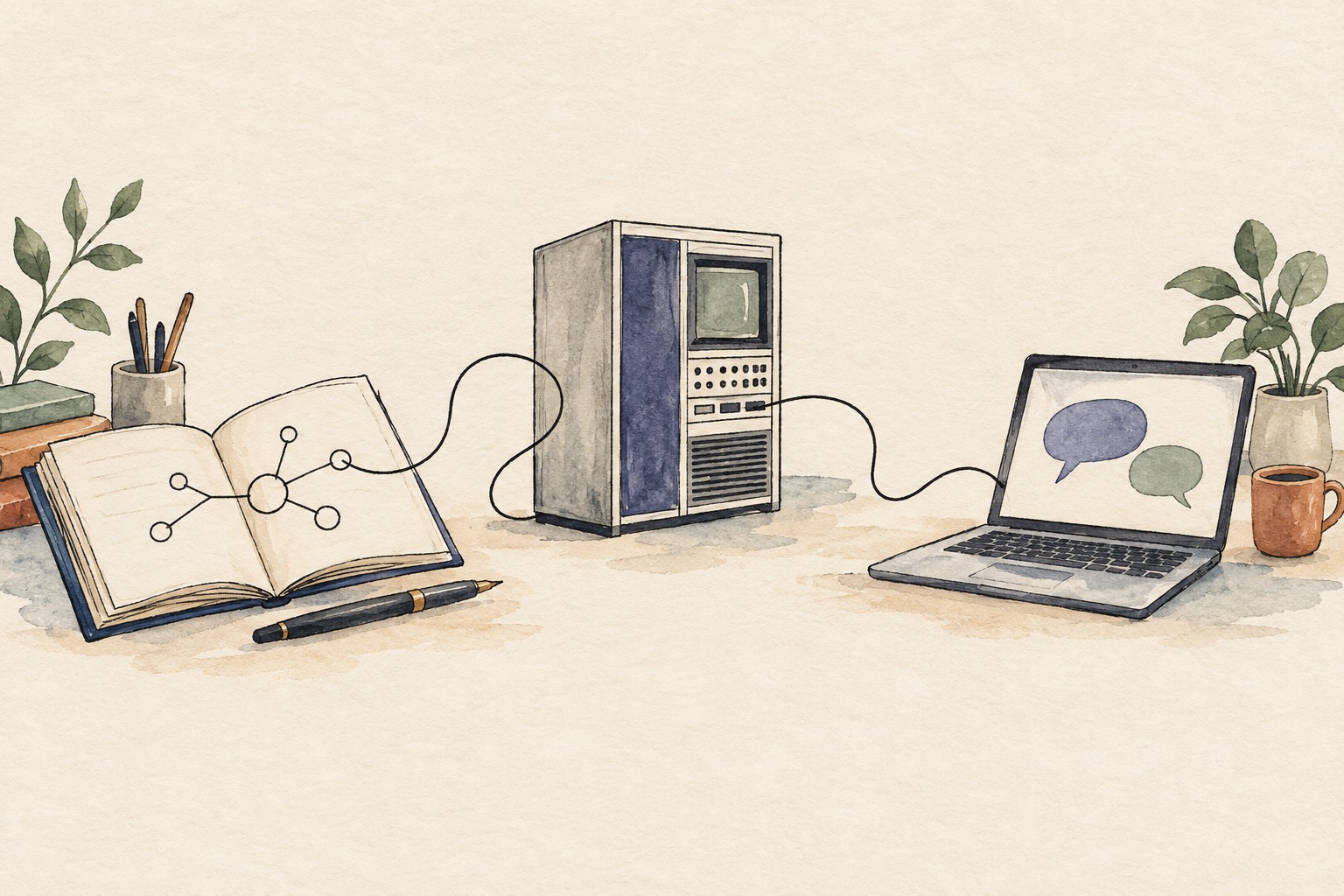
From ideas on paper to a conversation on screen: a conceptual illustration of the journey we are about to explore.
Before the interface, there was a question
In 1950, Alan Turing published a paper in the journal Mind whose opening sentence takes us straight to the problem:
“I propose to consider the question, ‘Can machines think?’”
Yes, in 1950. Think for a moment about the distance between writing that question and being able to ask a chatbot something from your phone today.
Turing proposed approaching it through an imitation game and also explored how to build machines that could learn. Toward the end of the paper, he considered both chess and teaching a machine to understand and speak English (Turing, 1950, pp. 459–460 (opens in a new tab)). Reading that passage today invites a pause: we have barely started our story, and language and games are already there.
Now, I am not going to settle whether machines can think here. What we can do is trace those capabilities. How did we get from imagining a machine that learns to building systems that recognize images, choose a move or answer a question? To find some pieces of the answer, we have to go back even a little further than Turing.
A short chronology of changing possibilities
First, there had to be a way to learn
In 1943, Warren McCulloch and Walter Pitts took an idea from biology — neurons receive signals and connect with one another — and turned it into a mathematical model. Their simplified units activated when excitatory signals reached a threshold, provided no inhibitory signal prevented it. Connected together, they could represent logical operations. Here we find one of the roots of artificial neural networks: studying what many simple units can do together (McCulloch & Pitts, 1943 (opens in a new tab)). Connecting units capable of logical operations was a starting point; getting a machine to learn or converse posed further problems.
Learning and conversation were precisely two capabilities that other researchers wanted to study, beyond any particular model of neurons. In 1955, the mathematician John McCarthy and three colleagues proposed a meeting at Dartmouth College, a university in Hanover, New Hampshire, in the United States. They would spend the summer of 1956 exploring how machines might use language, learn and solve problems. The Dartmouth proposal already used the term artificial intelligence (McCarthy et al., 1955 (opens in a new tab)). From that agenda, let us first follow learning: what would it mean to teach a machine something?
Imagine we want to teach it to distinguish one shape from another. We could try to write every recognition rule, or show it examples and find a way for it to adjust its responses. That second possibility takes us from McCulloch and Pitts’s model of connections to the problem of how to change them. In 1958, Frank Rosenblatt described the perceptron, a model inspired by the nervous system whose responses could change with experience (Rosenblatt, 1958 (opens in a new tab)). Adjusting the connections gave that idea of learning from experience a concrete form.
Learning from data or experience is what we call machine learning. It helps to place it within AI, the broader field named in the Dartmouth proposal. Deep learning is part of machine learning, using multiple layers of representation (Goodfellow et al., 2016, chap. 1 (opens in a new tab)). The distinction matters for what follows: not every AI system learns, and not all machine learning uses neural networks.
Conversation programs make the distinction easier to see. To give the impression of dialogue, it was also possible to use rules written by a person, without learning from examples. In 1966, Joseph Weizenbaum presented ELIZA, a program that transformed sentences using keywords and rules. One of its scripts simulated a psychotherapist's responses. Weizenbaum noted that a speaker could attribute knowledge and understanding to it that the speaker was contributing to the conversation (Weizenbaum, 1966 (opens in a new tab)). ELIZA leaves us with a caution to carry through this journey: a convincing reply may tell us less than we think about the mechanism producing it.
Let us return to the perceptron: being able to learn from examples did not mean it could solve every problem. In 1969, Marvin Minsky and Seymour Papert examined those limits in their book Perceptrons. They proved that the perceptron models they studied could not solve certain problems because of their structure. That conclusion concerned those particular models; it was not a proof that every neural network had the same limitations (Minsky & Papert, 1969 (opens in a new tab)).
The book’s influence on research is a separate question. It is often presented as the reason neural networks lost support, but that explanation is disputed: decisions about which research directions to promote and fund also played a part (Olazaran, 1996 (opens in a new tab)). To understand that period, we need to look at both the scientific results and the conditions under which research was carried out.

Work that carries on. A conceptual illustration.
The winters did not stop every idea
The institutions funding research were also evaluating what AI as a whole was achieving. In 1973, a report commissioned from James Lighthill by Britain's Science Research Council, a research funding body, challenged AI's achievements, partly because the possibilities to explore grew too quickly as problems became larger (Lighthill, 1973 (opens in a new tab)). Cuts in support during the 1970s in Britain and the United States had different causes and trajectories. Today they are retrospectively grouped under the expression AI winter, even though research continued (Hendler, 2008 (opens in a new tab); National Research Council, 1999 (opens in a new tab)). Note 1 distinguishes those funding decisions.
Work that continued during those years did not depend solely on getting networks to learn. Where a problem could be bounded and knowledge expressed as rules, expert systems offered another way to build useful tools. In 1982, John McDermott documented how R1 helped Digital Equipment Corporation configure computer orders and determine how their components should fit together (McDermott, 1982 (opens in a new tab)). Here, usefulness came from organizing specialist knowledge into rules. In networks with several layers, the difficulty was different: how to adjust connections from errors.
To see the difficulty, picture a network with several layers: its final answer depends on what happens in all of them. If that answer is wrong, how much should each connection change, including those far from the output? In 1986, David Rumelhart, Geoffrey Hinton and Ronald Williams showed how to use the error to calculate adjustments to connections through backpropagation. The numerical values of those connections, called weights, determine how strongly one unit influences another (Rumelhart et al., 1986 (opens in a new tab)). The error provided a signal for learning useful internal representations. The work helped spread the approach, with antecedents I discuss in note 2.
That technical advance coexisted with another winter toward the late 1980s. James Hendler described a combination of earlier funding cuts, tensions surrounding expert systems and specialized computers losing their market to cheaper machines (Hendler, 2008 (opens in a new tab)). A laboratory result and a commercial sector could be experiencing very different fortunes.
The research that continued brings us closer to another demand of conversation: remembering context. When we read a sentence, we interpret each word using what we have already read, sometimes much earlier. In the 1990s, getting a network to learn those relationships was still a problem. Recurrent networks maintain an internal state as they process a sequence, but the signal used to adjust their weights could weaken as it propagated through many steps: the vanishing gradient (Bengio et al., 1994 (opens in a new tab)). In 1997, Sepp Hochreiter and Jürgen Schmidhuber introduced long short-term memory (LSTM) to make those distant dependencies easier to learn (Hochreiter & Schmidhuber, 1997 (opens in a new tab)).
While LSTMs addressed that difficulty with sequences, another task Turing had mentioned offered a much more visible result. In the same year, 1997, in chess, IBM's Deep Blue defeated world champion Garry Kasparov in a six-game match. Years later, its team described a system of search, specialized hardware, position evaluation and databases of grandmaster games (Campbell et al., 2002 (opens in a new tab)). LSTM and Deep Blue shared a year, but solved different problems using different techniques. “AI” has never been the name of a single recipe.
From recognizing an image to choosing a move
A victory in chess did not exhaust the tasks still to tackle. Think of something as everyday as looking at a photograph and saying what is in it. To approach image recognition with deep networks, their multiple layers had to be trained. We have already seen backpropagation; other ways of doing this were also being investigated. In 2006, Geoffrey Hinton, Simon Osindero and Yee-Whye Teh proposed learning one layer at a time in a particular kind of deep network, a deep belief network (Hinton et al., 2006 (opens in a new tab)). Here, “deep” refers to multiple processing layers. That procedure was one research path; the visual recognition network we will meet shortly used a different approach to training.
To test what a network could learn from a photograph, a training method was not enough: it needed images to learn from and to evaluate its answers. Who collected those examples and decided what they contained? In 2009, Jia Deng and colleagues introduced ImageNet: images gathered from the web, organized into categories and checked through human work (Deng et al., 2009 (opens in a new tab)). The machine’s learning thus rested on the decisions and work of people preparing its examples.
ImageNet gave that recognition task a concrete scale. In 2012, Alex Krizhevsky, Ilya Sutskever and Geoffrey Hinton trained a deep convolutional network — layers that learn visual patterns — on two graphics processors, or GPUs. That architecture is known as AlexNet. For the ILSVRC-2012 visual recognition competition, they combined predictions from seven separately trained convolutional networks, including variants of the network. That ensemble achieved a 15.3% top-5 error rate, against 26.2% for the runner-up. Top-5 counts an error when the correct category does not appear among the system's five proposed labels (Krizhevsky et al., 2012 (opens in a new tab)). This was not the layerwise training of 2006: it used backpropagation, activation functions and techniques to reduce overfitting — learning the particularities of the training examples too closely.
Recognizing patterns could also help decide what to do. On a game board, for example, the task is to evaluate a position and choose the next move; describing what is there is only part of the work. AlphaGo, a program for playing the strategy game Go, combined neural networks, search over possible moves and reinforcement learning: training through reward signals, in this case also learning from games against itself. Its 2016 paper documented a 5–0 victory against Fan Hui, the European champion, in a match played in October 2015 (Silver et al., 2016 (opens in a new tab)). The networks helped propose moves and evaluate positions, guiding a search that could not examine every continuation.
The comparison with Deep Blue shows how the same task — choosing a move — could be approached with different combinations of techniques. In AlphaGo, the outcome of playing also provided a learning signal. Later, we will see how to take that idea into language, where judging a response requires something other than counting wins.

Before the next move. A conceptual illustration.
Language brings us back to the screen
To reach a machine that can converse, we need to pick up the work on language that was progressing alongside games. LSTMs had addressed learning relationships between distant parts of a sequence; translating a sentence was one task where those relationships mattered. Let us return to 2014, when Ilya Sutskever, Oriol Vinyals and Quoc Le showed how one LSTM network could encode a sentence and another produce its translation: sequence-to-sequence learning, or seq2seq (Sutskever et al., 2014 (opens in a new tab)).
In that translation, the original sentence was encoded into a fixed-size representation. Think of a long sentence: when writing a word of the translation, it would be useful to consult the part of the original needed at that moment. Also in 2014, Dzmitry Bahdanau, Kyunghyun Cho and Yoshua Bengio circulated a proposal that could weigh different parts of the original sentence when generating each word. The work was presented at the ICLR 2015 conference (Bahdanau et al., 2015 (opens in a new tab); 2014 preprint (opens in a new tab)). This attention mechanism allowed different parts of the original to be consulted instead of relying on one fixed representation.
Consulting different parts of a text turned out to be an idea that could take a much larger role in the design. In 2017, Attention is all you need introduced the Transformer, an architecture that organizes sequence processing around attention and dispenses with recurrent connections that traverse text step by step. The experiments focused on translation (Vaswani et al., 2017 (opens in a new tab)). Attention already had antecedents; what changed was its role in the architecture and how computation was organized.
With that family of architectures, working with language could take forms other than translation. BERT, developed by Jacob Devlin and colleagues, used context on both sides of a word to learn representations that could then be adapted to tasks such as answering questions about a passage. Its preprint appeared in 2018 and its conference paper in 2019 (Devlin et al., 2019 (opens in a new tab)).
We can now change the task: instead of examining a word with text on both sides, try continuing what is already written. That was another way to use the Transformer family. In 2019, OpenAI presented GPT-2, which learned to predict the next part of a text from what came before and could generate continuations spanning several paragraphs (Radford et al., 2019 (opens in a new tab)). The gesture is starting to feel familiar: we write a beginning and wait to see what follows.
That beginning could contain more than a sentence to finish: it could also show what we wanted to get back. In 2020, the OpenAI team showed with GPT-3 how to supply instructions and examples within the input text, without retraining the model for each task (Brown et al., 2020 (opens in a new tab)). If you have ever written “I want something like this” and added an example, the connection probably feels familiar.
The examples we write in a query, though, are not the same as the material used to train the model. Before it could respond that way, GPT-3 was trained on a mixture of web pages, books and Wikipedia; selecting and filtering that material was part of building the model (Brown et al., 2020, section 2.2 (opens in a new tab)). In 2022, the Chinchilla study examined how to divide a compute budget between model size and the amount of training text: increasing parameters without enough data left performance untapped (Hoffmann et al., 2022 (opens in a new tab)). Scale involved decisions about what to read and how much to train, as well as how many parameters to use.
Choosing the data and model size helped with training; there was also the problem we notice as users: continuing a text does not guarantee following someone’s request. In 2022, Long Ouyang and colleagues at OpenAI presented InstructGPT: first they used supervised fine-tuning on examples of human-written answers, then used human comparisons to train a reward model and improve responses through reinforcement learning. This is reinforcement learning from human feedback, or RLHF (Ouyang et al., 2022 (opens in a new tab)). The learning signal now included preferences about responses, in place of a game's outcome.
And so we return to November 30, 2022. The ChatGPT announcement described related training, adapted for dialogue using conversation demonstrations and RLHF (OpenAI, 2022 (opens in a new tab)). We are back at our opening screen: “Could you explain that another way?” can be our next message. That ease of use had changes in training behind it, as well as an accessible interface.
The introduction also warned that the system could give plausible but incorrect answers. ELIZA had left us with a question about the feeling of understanding; fluency could now accompany much broader capabilities without guaranteeing the truth of each reply. In 2023, the GPT-4 technical report described a model that accepted text and images and produced text, and again documented factual errors (OpenAI, 2023 (opens in a new tab)).
There are two stages behind that conversation worth distinguishing. During training, the model’s parameters are adjusted; during inference, the model uses those parameters to produce an answer. Inference also happens when a network recognizes an image: it is the point at which what has been learned is put to use.
In 2025, new releases of open-weight models expanded the options for trying them ourselves: their trained parameters could be downloaded to run, evaluate and adapt the model (Qwen Team, 2025 (opens in a new tab)).

Read, ask, read again. A conceptual illustration.
What changes when an idea becomes usable?
The evaluations we have seen tell us something about the models. But when we need to act on an answer, the question becomes more specific. Imagine our opening conversation applied to a company’s documents. The assistant responds clearly; we ask for an example, and it develops one. So far, the experience is still comfortable. As soon as we want to use that information to make a decision, other questions emerge: which document did it come from, is it current, and did we have permission to access it?
Checking those sources and permissions requires looking beyond the sentence on the screen. Along the way, we have been distinguishing pieces that come together here. The architecture describes how computation is organized; the trained model contains numerical values adjusted during training, such as the weights we saw earlier; and the application brings that model together with the information, tools and rules needed to solve the problem. On the screen we receive an answer, but its usefulness depends on how all those decisions fit together.
Reading the next announcement
The next announcement will probably arrive before we have finished exploring the previous ones. After this journey, we can greet it with curiosity and ask where the advance lies: in the architecture, the data, the training, how computation is used during inference or the interface that lets us use it. History has given us examples of why each of those pieces matters.
The references offer a way to continue from there. What task was evaluated, and what was the result compared with? What fell outside the test? There is no need to read every paper at once: we can start with the one that made us most curious and compare what it says with what is being announced.
The next time a machine explains something and you ask it to tell you another way, the scene will be much like the one at the beginning. Now, though, behind that answer we can recognize questions, experiments and contributions from many people over decades. AI has not just been born, and knowing its history helps us appreciate what continues to change.
Even after that journey, Turing's question is still waiting: can machines think? Knowing how we got here does not settle it. It leaves us better placed to keep talking about it.
About this revision
This is a revised version of my 2023 article in LatinXinAI on Medium (opens in a new tab). It keeps the question that started the article, expands the journey through neural networks and AI winters, checks the milestones against original publications and adds later research with a cutoff in September 2025.
Notes
-
Different decisions under the same metaphor. In Britain, the Lighthill report was part of a review of support for AI. In the United States, the 1969 Mansfield Amendment restricted military research funding to projects related to military functions. Years later, DARPA ended its Speech Understanding Research program, SUR, without funding a follow-on. The National Research Council documents these trajectories and the continuation of industrial research; “winter” does not mean a simultaneous worldwide shutdown (National Research Council, 1999, chap. 9 (opens in a new tab)). Return to the journey.
-
Backpropagation has antecedents. Linnainmaa developed reverse derivative computation in the context of rounding errors; his 1976 paper points back to his 1970 thesis (Linnainmaa, 1976 (opens in a new tab)). Werbos's 1974 dissertation already explained how to compute derivatives by traversing functional relationships in reverse (Werbos, 1974, chap. II (opens in a new tab)). That is why 1986 marks a milestone in learning representations here, rather than the invention of the entire procedure. Return to the journey.
References
Acosta Pereira, P. O. (2023, August 30). AI: Is it really something new? A brief chronology. LatinXinAI, Medium. Original article (opens in a new tab)
Bahdanau, D., Cho, K., & Bengio, Y. (2015). Neural machine translation by jointly learning to align and translate. 3rd International Conference on Learning Representations. ICLR 2015 (opens in a new tab). Conference paper (opens in a new tab). Preprint from 2014 (opens in a new tab)
Bengio, Y., Simard, P., & Frasconi, P. (1994). Learning long-term dependencies with gradient descent is difficult. IEEE Transactions on Neural Networks, 5(2), 157–166. https://doi.org/10.1109/72.279181 (opens in a new tab)
Brown, T. B., Mann, B., Ryder, N., Subbiah, M., Kaplan, J., Dhariwal, P., Neelakantan, A., Shyam, P., Sastry, G., Askell, A., Agarwal, S., Herbert-Voss, A., Krueger, G., Henighan, T., Child, R., Ramesh, A., Ziegler, D. M., Wu, J., Winter, C., . . . Amodei, D. (2020). Language models are few-shot learners. In H. Larochelle, M. Ranzato, R. Hadsell, M. F. Balcan, & H. Lin (Eds.), Advances in Neural Information Processing Systems (Vol. 33, pp. 1877–1901). Curran Associates. Conference proceedings (opens in a new tab). Preprint from 2020 (opens in a new tab)
Campbell, M., Hoane, A. J., Jr., & Hsu, F.-h. (2002). Deep Blue. Artificial Intelligence, 134(1–2), 57–83. https://doi.org/10.1016/S0004-3702(01)00129-1 (opens in a new tab)
Deng, J., Dong, W., Socher, R., Li, L.-J., Li, K., & Fei-Fei, L. (2009). ImageNet: A large-scale hierarchical image database. In 2009 IEEE Conference on Computer Vision and Pattern Recognition (pp. 248–255). IEEE. https://doi.org/10.1109/CVPR.2009.5206848 (opens in a new tab)
Devlin, J., Chang, M.-W., Lee, K., & Toutanova, K. (2019). BERT: Pre-training of deep bidirectional transformers for language understanding. In J. Burstein, C. Doran, & T. Solorio (Eds.), Proceedings of the 2019 Conference of the North American Chapter of the Association for Computational Linguistics: Human Language Technologies, Volume 1 (Long and Short Papers) (pp. 4171–4186). Association for Computational Linguistics. https://doi.org/10.18653/v1/N19-1423 (opens in a new tab). 2018 preprint (opens in a new tab)
Goodfellow, I., Bengio, Y., & Courville, A. (2016). Deep learning. MIT Press. Chapter 1 (opens in a new tab)
Hendler, J. (2008). Avoiding another AI winter. IEEE Intelligent Systems, 23(2), 2–4. https://doi.org/10.1109/MIS.2008.20 (opens in a new tab)
Hinton, G. E., Osindero, S., & Teh, Y.-W. (2006). A fast learning algorithm for deep belief nets. Neural Computation, 18(7), 1527–1554. https://doi.org/10.1162/neco.2006.18.7.1527 (opens in a new tab)
Hochreiter, S., & Schmidhuber, J. (1997). Long short-term memory. Neural Computation, 9(8), 1735–1780. https://doi.org/10.1162/neco.1997.9.8.1735 (opens in a new tab)
Hoffmann, J., Borgeaud, S., Mensch, A., Buchatskaya, E., Cai, T., Rutherford, E., de Las Casas, D., Hendricks, L. A., Welbl, J., Clark, A., Hennigan, T., Noland, E., Millican, K., van den Driessche, G., Damoc, B., Guy, A., Osindero, S., Simonyan, K., Elsen, E., . . . Sifre, L. (2022). An empirical analysis of compute-optimal large language model training. In S. Koyejo, S. Mohamed, A. Agarwal, D. Belgrave, K. Cho, & A. Oh (Eds.), Advances in Neural Information Processing Systems (Vol. 35, pp. 30016–30030). Curran Associates. Conference proceedings (opens in a new tab)
Krizhevsky, A., Sutskever, I., & Hinton, G. E. (2012). ImageNet classification with deep convolutional neural networks. In F. Pereira, C. J. C. Burges, L. Bottou, & K. Q. Weinberger (Eds.), Advances in Neural Information Processing Systems (Vol. 25, pp. 1097–1105). Curran Associates. Conference proceedings (opens in a new tab)
Lighthill, J. (1973). Artificial intelligence: A general survey. In Artificial intelligence: A paper symposium. Science Research Council. Report and responses (opens in a new tab)
Linnainmaa, S. (1976). Taylor expansion of the accumulated rounding error. BIT Numerical Mathematics, 16, 146–160. https://doi.org/10.1007/BF01931367 (opens in a new tab). (Refers back to his 1970 thesis).
McCarthy, J., Minsky, M. L., Rochester, N., & Shannon, C. E. (1955, August 31). A proposal for the Dartmouth summer research project on artificial intelligence. Original proposal (opens in a new tab)
McCulloch, W. S., & Pitts, W. (1943). A logical calculus of the ideas immanent in nervous activity. Bulletin of Mathematical Biophysics, 5, 115–133. https://doi.org/10.1007/BF02478259 (opens in a new tab)
McDermott, J. (1982). R1: A rule-based configurer of computer systems. Artificial Intelligence, 19(1), 39–88. https://doi.org/10.1016/0004-3702(82)90021-2 (opens in a new tab)
Minsky, M., & Papert, S. A. (1969). Perceptrons: An introduction to computational geometry. MIT Press. Original edition (opens in a new tab)
National Research Council. (1999). Funding a revolution: Government support for computing research. National Academies Press. https://doi.org/10.17226/6323 (opens in a new tab). Chapter 9 (opens in a new tab)
Olazaran, M. (1996). A sociological study of the official history of the perceptrons controversy. Social Studies of Science, 26(3), 611–659. https://doi.org/10.1177/030631296026003005 (opens in a new tab)
OpenAI. (2022, November 30). Introducing ChatGPT. Launch announcement (opens in a new tab)
OpenAI. (2023). GPT-4 technical report (Version 1) [Preprint]. arXiv. arXiv:2303.08774v1 (opens in a new tab)
Ouyang, L., Wu, J., Jiang, X., Almeida, D., Wainwright, C. L., Mishkin, P., Zhang, C., Agarwal, S., Slama, K., Ray, A., Schulman, J., Hilton, J., Kelton, F., Miller, L., Simens, M., Askell, A., Welinder, P., Christiano, P. F., Leike, J., & Lowe, R. (2022). Training language models to follow instructions with human feedback. In S. Koyejo, S. Mohamed, A. Agarwal, D. Belgrave, K. Cho, & A. Oh (Eds.), Advances in Neural Information Processing Systems (Vol. 35, pp. 27730–27744). Curran Associates. Conference proceedings (opens in a new tab)
Qwen Team. (2025, April 29). Qwen3: Think deeper, act faster. Release announcement (opens in a new tab)
Radford, A., Wu, J., Child, R., Luan, D., Amodei, D., & Sutskever, I. (2019). Language models are unsupervised multitask learners [Technical report]. OpenAI. Original report (opens in a new tab)
Rosenblatt, F. (1958). The perceptron: A probabilistic model for information storage and organization in the brain. Psychological Review, 65(6), 386–408. https://doi.org/10.1037/h0042519 (opens in a new tab)
Rumelhart, D. E., Hinton, G. E., & Williams, R. J. (1986). Learning representations by back-propagating errors. Nature, 323, 533–536. https://doi.org/10.1038/323533a0 (opens in a new tab)
Silver, D., Huang, A., Maddison, C. J., Guez, A., Sifre, L., van den Driessche, G., Schrittwieser, J., Antonoglou, I., Panneershelvam, V., Lanctot, M., Dieleman, S., Grewe, D., Nham, J., Kalchbrenner, N., Sutskever, I., Lillicrap, T., Leach, M., Kavukcuoglu, K., Graepel, T., & Hassabis, D. (2016). Mastering the game of Go with deep neural networks and tree search. Nature, 529, 484–489. https://doi.org/10.1038/nature16961 (opens in a new tab)
Sutskever, I., Vinyals, O., & Le, Q. V. (2014). Sequence to sequence learning with neural networks. In Z. Ghahramani, M. Welling, C. Cortes, N. Lawrence, & K. Weinberger (Eds.), Advances in Neural Information Processing Systems (Vol. 27). Curran Associates. Conference proceedings (opens in a new tab)
Turing, A. M. (1950). Computing machinery and intelligence. Mind, 59(236), 433–460. https://doi.org/10.1093/mind/LIX.236.433 (opens in a new tab)
Vaswani, A., Shazeer, N., Parmar, N., Uszkoreit, J., Jones, L., Gomez, A. N., Kaiser, Ł., & Polosukhin, I. (2017). Attention is all you need. In I. Guyon, U. von Luxburg, S. Bengio, H. Wallach, R. Fergus, S. V. N. Vishwanathan, & R. Garnett (Eds.), Advances in Neural Information Processing Systems (Vol. 30). Curran Associates. Conference proceedings (opens in a new tab). Preprint from 2017 (opens in a new tab)
Weizenbaum, J. (1966). ELIZA—a computer program for the study of natural language communication between man and machine. Communications of the ACM, 9(1), 36–45. https://doi.org/10.1145/365153.365168 (opens in a new tab)
Werbos, P. J. (1974). Beyond regression: New tools for prediction and analysis in the behavioral sciences [Doctoral dissertation, Harvard University]. Original text (opens in a new tab)